
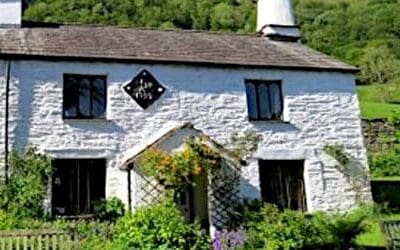
Re roofing this property was essential
Mark and Denise thought they had found their dream house, a charming cottage in the countryside. But they could only obtain a mortgage on condition that the house was re roofed within a year. However, moving in during winter, they were dismayed at how cold the bedrooms were and then horrified when the heating bill arrived.
Initial thoughts were to use 1F Felt
They were optimistic that when re-roofing, rafter-level insulation could go in, if not to current standards, then enough to make a difference to the heating costs. However, with the proximity of a stream and a known bat roost in a nearby barn, the requirement for an ecologistâₒs report was triggered. Bitumen felt should be used in case individual bats were to use any gaps under the handmade clay tiles as transient roosts. Since bats claws can become entangled in the fibres of conventional breather membranes, 1F was the recommendation.
But Upon further inspection
When the roofing contractor lifted a few tiles to assess the rafter depth and determine the maximum amount of insulation material that could be fitted, he pointed out that even though the rafters were 75mm, because of the lath and plaster ceiling intruding from below, the effective depth was only 65mm. This space also had to accommodate the 10-15mm sag of the breather membrane, meaning that the maximum insulation that could be fitted was 50mm PIR, this would then only achieve 0.48 W/m2K. This is some way from the current part B regs requirement of 0.18 W/m2K. But it would in fact yield a heat loss saving of 88%, and thus offer significant benefit.
One problem though, 1F is not breathable¦
However, the requirement for a bitumen felt changed things completely. Because this type of non-breathable underlay needs a 50mm ventilated space beneath – which would make introducing any insulation impossible! âₓ with the U-value being that of the uninsulated roof at 3.94 W/m2K. At a time when energy conservation is at the forefront of everyoneâₒs mind it seemed unacceptable to have no insulation.
There was however, one more option:
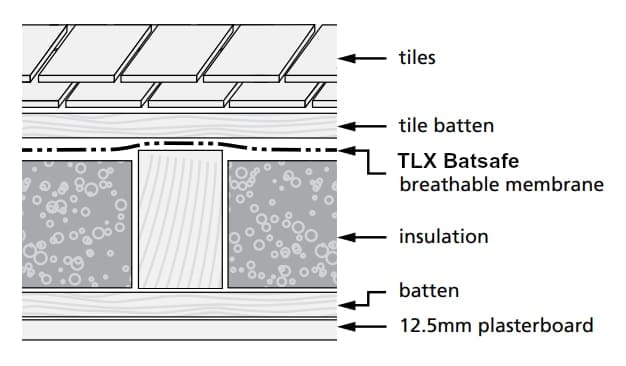 A compromise solution was found by using TLX Insulationâₒs Batsafe membrane. This has mesh bonded to each side of the breather membrane. It offers bats something to grip onto and prevents contact with the polypropylene fibres of the breather membrane. This ensures that bats can never become caught up in them.
The result?
Substantial reductions in heating bills and zero risk to any bat which may choose to roost under a tile.