

Developing near conservation areas requires careful planning
If faced with a new development in an area which is desirable, but the desirability also extends to nearby Bats, what is the best solution when faced with this concern?
When looking at a small development (surrounded by, or near woodland) the very proximity of this means it may also be a desirable habitat for bats. And, as a protected species, you need mitigation measures to ensure their welfare œ in particular, that the construction fabric does not pose a risk.
1F felt has always been recommended in the past?
Recent research has shown there is a danger of bats becoming entangled in modern breather membranes. Their claws can catch within the membrane ¢s polypropylene fibres. This results in the trapping of the bat. Because of this, ecologists recommend bitumen felt in a cold roof design rather than a breather membrane. Because these felts are vapour-impermeable, this would mean that the loft would need to be fully ventilated.
So 1f felt is not the best solution, mainly because more heat loss would occur via the roof. This is because of the introduction of cold outside air to ventilate. But also because if 300mm of mineral wool insulation is specified for the floor of the loft, it would be less effective. Since it ¢s permeable to air which would blow through the upper layers.
 New house design

New house design can often offer buyers the opportunity of converting the loft to a room at a later stage and using it for storage in the meantime. The concern is that having a ventilated loft with an open invitation to the bats to use as a roost, can make things difficult for the future owners both in terms of a potential loft conversion and because of the droppings they might create, falling onto the insulation and any stored items, making it impossible to clean, not to mention a health risk.
It is also likely that on the outside, individual bats might use the gaps under the tiles as transient roosts. Although, the risk of becoming trapped in such circumstances is small.
So, in terms of new build, what is the best way to proceed?
 the best way to proceed?
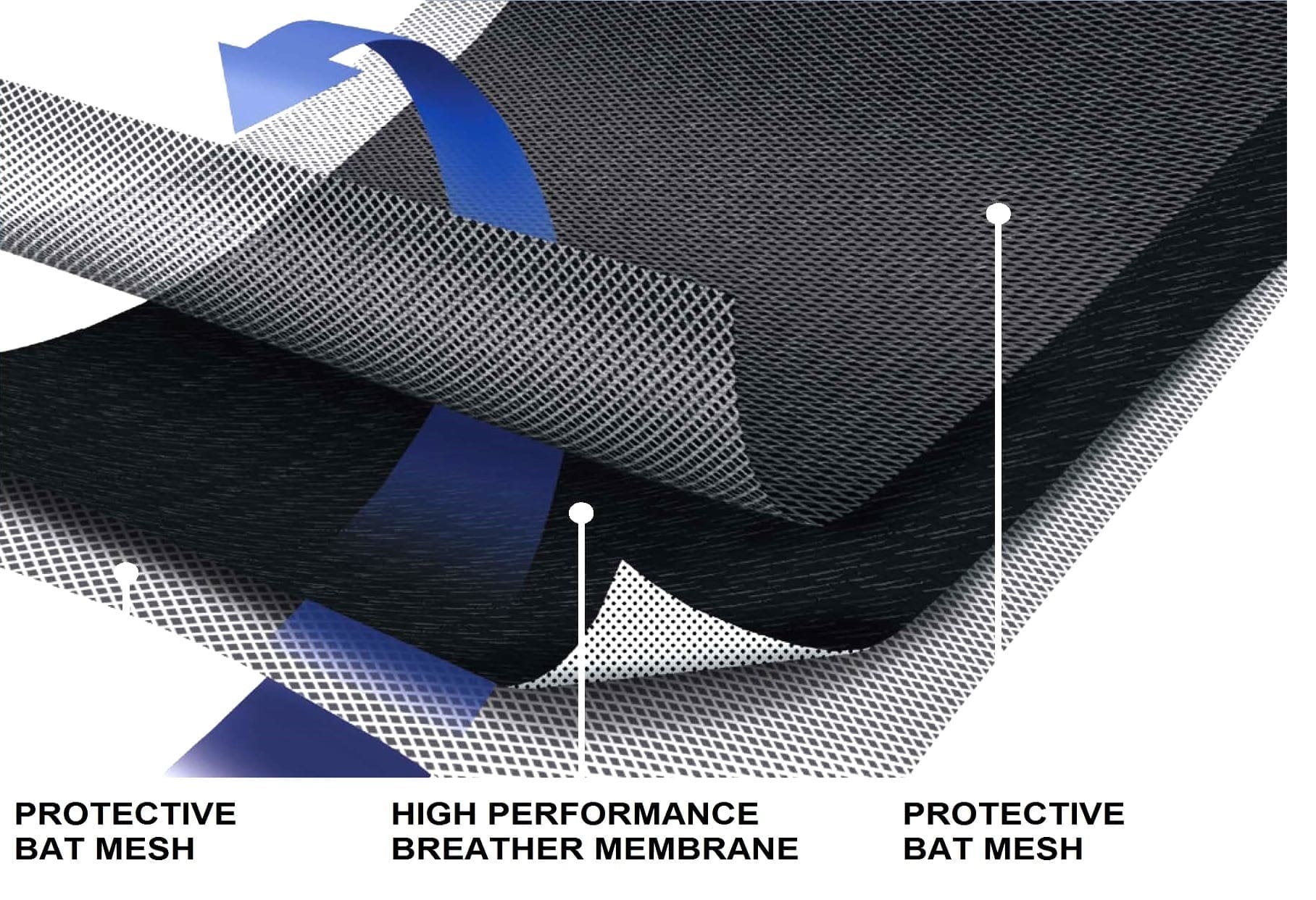
A compromise can be reached by using TLX Batsafe breather membrane, which is a conventional membrane with 2mm mesh either side so bats can cling without risk of contacting the membrane in-between. Use a similar size mesh in retrofits where there are roosts within lofts under breather membranes. The product has also been tested using a machine designed to mimic the abrasion produced by bat claws over extended periods and is fully LABC certified.
There would then be zero risk to any bats roosting under the tiles. This is because new build properties use a vapour barrier under the ceiling joists. This prevents water vapour from entering the loft. So, having a cold unventilated loft is possible, which comes with the corresponding energy savings. In addition, with the loft completely sealed, there should be no entry points for bats. Plus, the owners would not need to share their loft space with visitors!