4 Minute read
 What is pitched roof insulation?
You can use many types of insulation to reduce heat loss and provide a more comfortable living environment. These range from more traditional types of insulation such as rigid board and mineral wool, to multifoil insulation which controls all three forms of heat transfer: convection, conduction and radiation.
Place multifoil insulation where heat loss is more prevalent, such as a pitched roof. Because this is to protect a building from variations in external temperature. Additionally, the effectiveness of insulation material is measured by its Core R value, its ability to prevent heat transfer, therefore, the higher the R value, the better the insulation.
With building regulations becoming more demanding, it is key to have the most effective insulation build-up to ensure the greatest thermal efficiency. This is increasingly difficult nowadays as we have a varied housing stock in the UK with many unique roof structures. Using multifoils in conjunction with PIR board or mineral wool is the best way to achieve a thermally efficient structure.
How to install pitched roof insulation

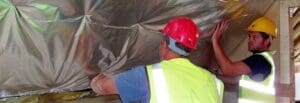
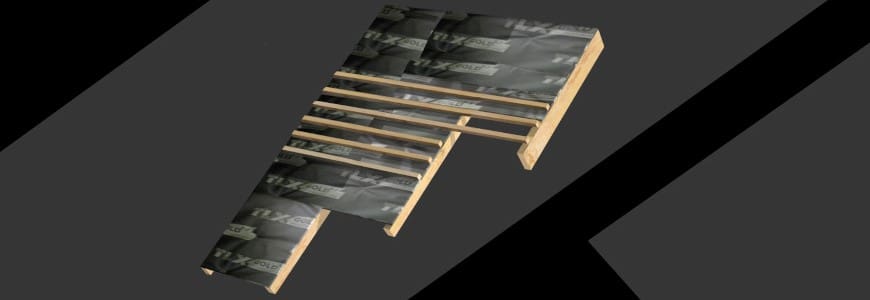
This largely depends upon the type of insulation used. There is a great variety of insulation materials which perform different roles within the make-up of a roof. You can install a multifoil above or below rafters, fixed with battens to secure them in place. Then fit mineral wool or PIR board in-between the rafters. These different insulation materials interact and work together to provide a thermally efficient system.
The best performing pitched roof insulation
Our TLX multifoils are the ideal thickness meaning they are thick enough to ensure their optimum level of performance without compromising head height or the need to raise the roofline. Plus, TLX Silver and TLX Gold provide complete airtightness which helps to minimize the risk of condensation. Our multifoils are manufactured in the UK and are BBA approved.
Pitched roof insulation over rafters?
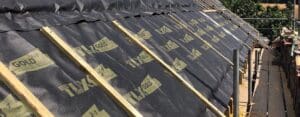
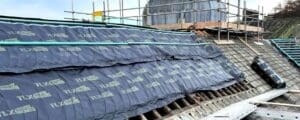
We recommend using our 2-in-1 insulating breathable membrane, TLX Gold over the rafters. Simply taking the place of a standard breathable membrane. TLX Gold also provides an effective insulation layer with is shiny, breathable under surface used to reflect heat back into the building. Furthermore, maintain a minimum 10mm unventilated air layer beneath TLX Gold to ensure optimal performance.
Pitched roof insulation under rafters?
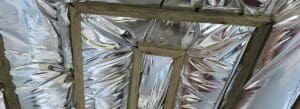
Use TLX Silver insulating vapour barrier on the underside of the rafters. Its reflective layers interspersed with layers of wadding. These provide a barrier to heat transfer and prevent condensation by reflecting heat back into the building.
How much insulation do I need in pitched roof?
The depth of insulation required is dependent on the U value requirements of the structure. A U value refers to the amount of heat lost through a structure. For a new build, you need to meet 0.18w/m2k, although listed buildings are exempt.
The use of TLX Silver and TLX Gold can be used to significantly reduce the amount of additional insulation needed within the rafter to achieve building regulations. Plus, if you have a material with a high R value, you need less of it to achieve the desired U value. For instance, if using TLX Silver underneath the rafters, fitting 85mm of PIR board in-between the rafter will achieve 0.18w/m2k in a 125mm rafter based on 400mm rafter centres.