4 Minute read
Target U-Value 0.28 W/mK?
Solid walls can be of variable construction and materials, but if your project is under Building Control they will be looking for a U-value of 0.28 W/mK if it is a new wall or 0.30 W/mK if it is an existing wall. If there is a cavity wall, the cavity is not of significant thermal value unless you fill it with insulation. If the inner skin is a modern Thermalite block, this has far better insulating ability than the old dense concrete types. Plus, you will require very little additional insulation.
The exact U-Value can depend on the bridging factor
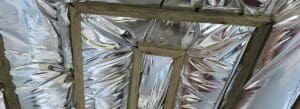
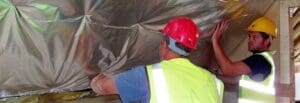
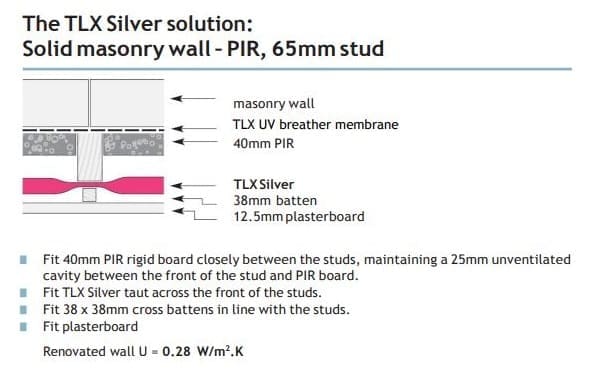
For a brick, concrete or stone wall then the best way to insulate internally is to set studs against the wall. The exact achievable U value depends on the bridging factor. I.e. the thickness of the studs / their spacing, but the examples below give approximate requirements. The 0.28 W/mK example on our website is based on a 65mm deep stud with 40mm PIR set against the wall, TLX Silver stapled to the inner face and secured with a 38 mm deep batten, and makes use of unventilated heat-reflecting air gaps either side of the TLX Silver to contribute to the thermal performance.
 An alternative using more readily available batten sizes would be to fully fill with PIR between 50 mm deep studs, staple the TLX Silver on directly and secure with a 50 mm deep batten. The 20mm unventilated air space also serves as a useful service cavity to run cables up the wall.
Creating a barrier to vapour
TLX Silver is CE marked as a vapour barrier, preventing water vapour from migrating to the cold side of the insulation, where it could condense against the cold outer wall. It is advisable to use a breather membrane against the wall. As this would allow any trapped water to permeate through to the outside “ albeit slowly “ when conditions are warmer, whereas a damp-proof membrane would seal it in. It is essential that any breach in the vapour barrier should be made good by patching and sealing, e.g. behind light fittings and electrical sockets.
Which stud depth?
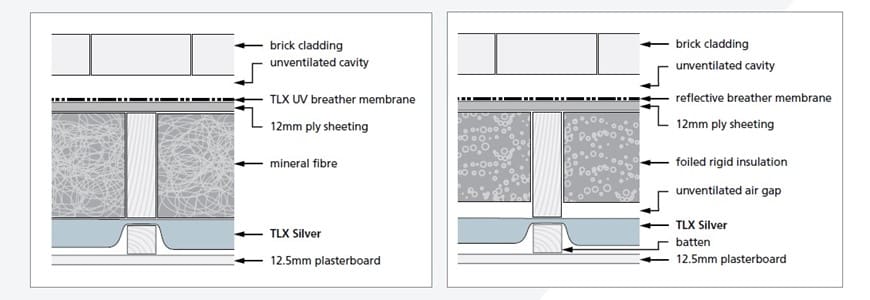
Often an extension or refurb plans have a somewhat arbitrary choice of stud at 75mm or 100mm, without planning for the U value requirement. When the builder then wants to use mineral wool to save material and labour costs, he finds that fully filling the studs won’t meet 0.28 W/mK.
You can achieve this by adding TLX Silver internally. Plus, there’s an added benefit of not requiring a vapour barrier nor insulated plasterboard. Although the precise buildup would depend on the grade of mineral wool used and the bridging factor, examples are:
| 100 mm stud, 0.044 W/mK wool | TLX Silver | 38 mm deep batten “ 0.30 W/mK |
| 100 mm stud, 0.040 W/mK wool | TLX Silver | 38 mm deep batten “ 0.28 W/mK |
| 75 mm stud, 0.038 W/mK wool | TLX Silver | 38 mm deep batten “ 0.30 W/mK |
| 75 mm stud, 0.035 W/mK wool | TLX Silver | 38 mm deep batten “ 0.28 W/mK |
Best batten size?
Where a result is required as quickly as possible at minimum cost, then simply sandwiching TLX Silver multifoil between two 25mm deep battens will achieve a U value of 0.47 W/m2K. This is particularly popular where there are walls with uneven surfaces, as the combination of battens and the flexible blanket enables the adjustments necessary to achieve a flat internal finish.
And if the studwork is Steel?
Where there is steel studwork, however, it is not possible to either staple TLX Silver nor to screw through it. This is because the screws snag on the polyester fibres. So if it is planned to use the two together a batten should be used between the two. Plus, the bridging factor of the steel sections needs to be accounted for in any U-value calculation.
Read the case study related to this post
Click to view our LABC registered TLX Silver (wall) solutions