
3 Minute read
-
Not all roofs are created equal, but if you need to achieve U-0.18 what are the variables you should consider?
-
Shallow rafters can prove problematic
It’s a question of three things: ceiling type, roof covering and headroom
How you will tackle this will depend on whether there is an existing ceiling, the type of external roof covering and how much headroom is available. Where it’s not technically feasible to achieve a U value of 0.18 W/mK, a value of 0.35 W/mK is the target, and for a listed building (or where 0.35 W/mK is simply not achievable) 0.70 W/mK is the limiting value.
A Shallow rafter isn’t a problem here?
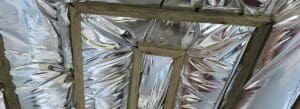
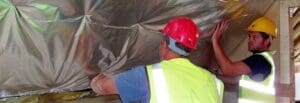
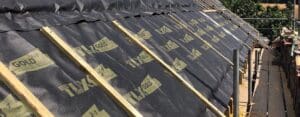
TLX Gold can be draped between the rafters (with the usual 10mm breather membrane sag), and since it is 33mm thick but compresses to 3mm under the tile battens, it will therefore occupy the topmost 40mm of rafter space. It needs an unventilated air gap underneath “ a minimum of 10mm but ideally 20mm “ to reflect heat back from its shiny yet fully breathable underside. So if there is a plasterboard ceiling below, it should be possible to fit a maximum of 25mm of PIR board, giving a U value of 0.44 W/mK.
Fitting additional insulation can help reduce your U Value further
By way of comparison, a solution using rigid board alone would be to fit 50mm PIR at the bottom of the rafters, leaving an unventilated space under the breather membrane, to give a U value of 0.46 W/mK. But the big advantage of using TLX Gold over an all-PIR solution is that there is no condensation risk. Even where the existing ceiling does not have a vapour barrier. A common scenario, especially in old Listed buildings, is that there is a lath and plaster ceiling which may intrude into the rafter space, making fitting PIR board unrealistic in 75mm rafters. In this case a U value of 0.69 W/mK is achieved with a single layer of TLX Gold.
A small increase in roof height could make all the difference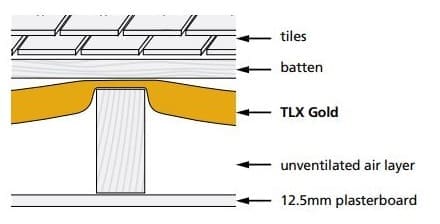
If there is scope to raise the roof slightly, TLX Gold can be taut and counter battened. This allows the use of an additional 20mm PIR.
The U value is literally a measure of heat loss through the roof. You measure this in Watts, for every square metre, for every degree temperature difference). Given that an uninsulated roof with a bitumen felt has a U value of 3.85 W/mK, the U = 0.69 W/mK provided by TLX Gold amounts to an energy saving of 82% [(3.85-0.69)/3.85%]. View the case study here.
And Vaulted Ceilings?
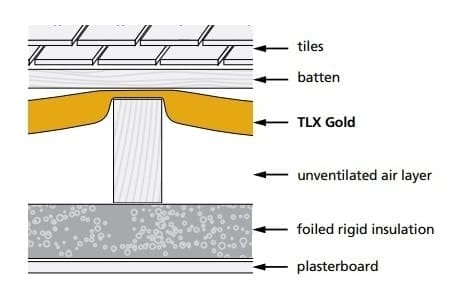
If there is a vaulted ceiling then loss of headroom is generally not a problem. So draping TLX Gold between the rafters and running 85mm PIR board underneath achieves U = 0.18 W/mK. If there are purlins and the PIR between, there is a small adjustment to the bridging factor used in the calculation.
Re roofing where existing insulation and 1F Felt is present
There are also reroof scenarios where there is existing insulation and a bitumen felt with a 50mm space underneath it. TLX Gold then can quite neatly replace the bitumen felt without raising the roof. As 50mm is the minimum requirement to use it draped with an air gap below. For example, in a 100mm rafter with a bitumen felt and 50mm PIR below, the U value is 0.52 W/mK.
To improve this, you may think to put another 25mm PIR on top underneath a breather membrane, this would contradict the rule of thumb that says the thicker board should always be on the cold side, otherwise condensation may occur at the interface. View the case study here.
Moreover if you don’t know whether there is a vapour barrier or not on the existing ceiling, then water vapour can enter from below and there will be a condensation risk. By fitting the TLX Gold draped between the rafters in place of the bitumen felt, it brings the U value to 0.33 W/mK, with the benefit of being condensation risk-free even if there is no vapour barrier below.
Remember, TLX Gold is the only product of its type which you can drape, to provide these solutions.