
3 Minute read
-
Multifoil insulation is clever, it will keep a space warm in winter, yet cool in the summer
-
Did you know parts of the stadium in Doha, Qatar feature TLX Silver which helps keep it cool during the summer months
Too hot in summer?
In recent years, with the Building Regulations requiring loft conversions to be well insulated, freezing attic rooms are things of the past. However they can be still be draughty, and stifling hot in summer even with the windows open.
Time to cool it down…
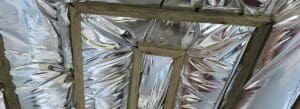
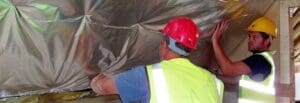
Using multifoil insulation as part of the overall build-up can provide more benefits than just reducing heat loss. Being a vapour barrier it also provides airtightness (if it is correctly taped) “ so no more draughts. Its shiny surface reflects 95% of radiated heat back into the room across an air gap next to it “ a heat mirror in effect.
But how does the same shiny surface also keep things cool?
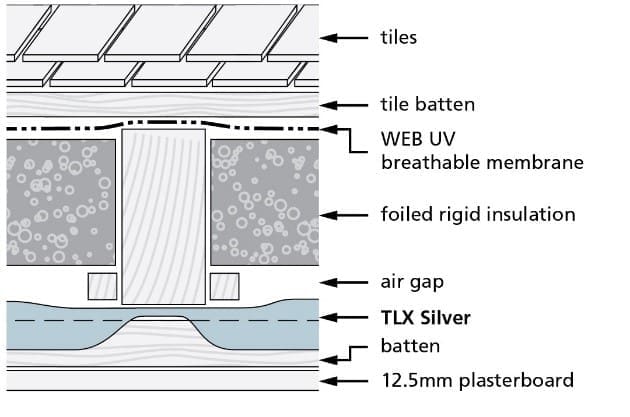 A material that reflects 95% of heat radiation absorbs the other 5% – but then it only emits 5% of heat as radiation. That’s why these surfaces are known as low emissivity surfaces. So having a material with such a low emissivity surface as part of the insulation build-up means that the heating effect of the sun’s rays is partially blocked, since most of the transmission by infra-red radiation across the air gaps is prevented. The same principle is used in the internal construction of the product. With internal shiny layers reflecting heat back across the air spaces between the polyester fibres.
It’s all about reflectance
A polished aluminium surface has an emissivity of around 0.05. In other words 95% of the heat is reflected. The surfaces metallised with aluminium are the best heat reflectors that can be made.
It’s very difficult to measure this, and in fact the relevant standard relating to the thermal performance of reflective insulation products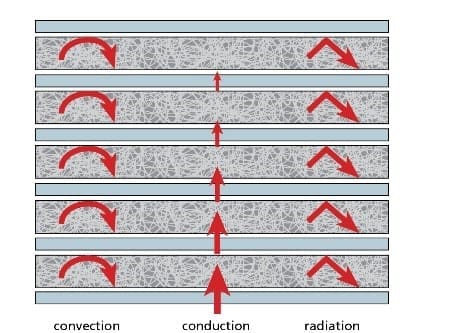 BS EN 16012:2012 notes that measurement errors increase significantly below 0.05, and that even if the average of the measurements made does end up less than 0.05, the value should only be declared as 0.05.
So why do some products quote lower surface emissivities “ 0.02 or 0.03 “ than this? Well, it will boost the calculated thermal resistance (R value) of the air gap used in the U-value calculation, which will make the product appear to be better, when it may not necessarily be the case.
TLX Silver in practice
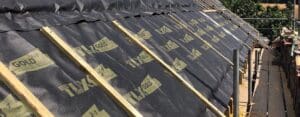
Our TLX Silver 2-in-1 insulating vapour barrier has an emissivity value of 0.05. It is extremely effective at minimising heat gain during the day, yet prevents heat being radiated at night time. This proved to be the ideal material for use in the Doha stadium. It keeps players and crowds cool throughout the day, yet retains heat when the cool desert air comes at night. TLX Silver is responsive to changes in the environment. When winter draws in, heat is reflected from its low emissivity surfaces. Plus, the air spaces either side inhibit conductive and convective heat transport.