
4 minute read
Insulating historic buildings has many challenges, therefore they require different approaches to improving the insulation. The buildings listed below are typically difficult to insulate:
Is Multifoil Insulation Suitable for Boarded Roofs in Historic Buildings?
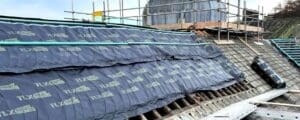
You can often find boarded roofs in old buildings. They are tricky to insulate because the rafter space is separated from the roof by a board. You would generally fit insulation between the rafters, but you can’t in boarded roofs. The boards are thick and take up a lot of room. Additionally, the rafters are usually quite shallow, making it impossible to meet building requirements with traditional forms of insulation alone. Furthermore, if the building is listed, alterations may be limited.
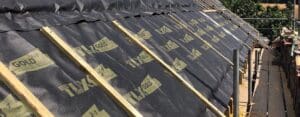
When The Museum of Gloucester needed a re-fit, a compromise had to be agreed between the roofers and local building control. Improvements to the roof insulation was long overdue, whilst maintaining a conscientious approach to the constructional constraints of the Grade II listed building. Our technical team worked alongside Minster to establish the best solution for the contractor. Conclusively, they agreed to use TLX Gold because it provides an excellent thermal performance without considerably raising the roof height.
How to Install Multifoil Insulation in Historic Buildings
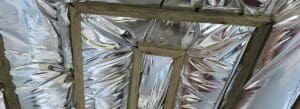
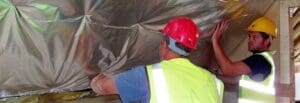
It is possible to insulate a boarded roof using multifoil insulation. Here is how to do it:
|
|
|
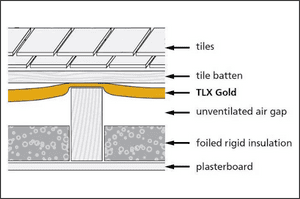 Roofers at the Museum of Gloucester project welcomed the specification of TLX Gold as a single layer used in this way, giving a U -Value of 0.67 W/m2K. When compared with a completely uninsulated roof having a U value of 3.67w/m2k, this is a substantial thermal energy saving, especially for a listed building where building regulations donâₒt apply; TLX Gold was able to maximise the thermal efficiency of this construction.
A continuous sheet of PIR between the board and the counter-battens can reduce it much further if you can raise the roofline. For instance, use 85mm of PIR board to reach 0.18w/m2k.
How Does TLX Gold Work to Achieve Lower U-Values?
TLX Gold reflects heat. It is a very effective insulator. In this way, the 50mm counter-batten acts as a mini rafter creating the space beneath TLX Gold for the maintenance of the air layer. The under surface of TLX Gold enhances the core R-Value of the air layer next to it, so the U value is greatly improved.
Preventing Condensation: You may be wondering, if a 50mm ventilated air space is required below non-breathable felt, why then does TLX Gold require a 20mm unventilated air gap underneath it? And how does TLX Gold prevent condensation? Indeed, whilst the under surface reflects heat, it is also fully breathable. This allows water vapour to pass through it. TLX Gold occupies the coldest part of the temperature profile. Water vapour entering the rafter space from below can escape through the breathable layers before it cools and condenses. When installed in accordance with the TLX installation guide, there is no risk of surface or interstitial condensation.
Do you Require a Bespoke Solution?
We would love to hear from you. Our helpful team of product experts are on hand to help with bespoke solutions and U-Value calculations. Simply call 01204 674 709. Also, our LABC-approved solutions guide has a wide range of pre-calculated solutions. You can download your free copy from the footer below.