
3 Minute read
They may have character, but they’re not always easy to work with
These exposed purlins are full of character “ but if the purlins are this irregular then just think what the rafters are like! Unless the rafters are completely replaced, working with original rafters in very old buildings is tricky. In some cases the rafters are little more than logs. And where there is a room in the roof, the problem is then how to introduce insulation that will preserve the exposed purlins.
The solution?
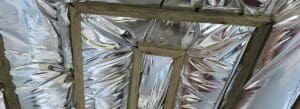
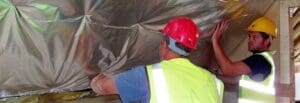
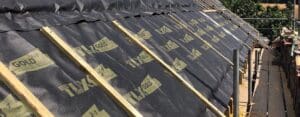
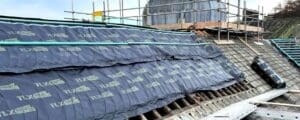
As long as the rafter centres are >350 mm TLX Gold can be draped between them, with the usual 10 mm sag, which will mean that the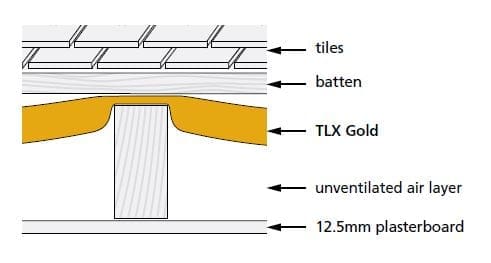 roof need not be raised “ an essential condition if the property is in a conservation area. Even if counter battening is necessary, because TLX Gold compresses to only 3mm the height increase is minimal. Just using TLX Gold by itself in, say, 75 mm rafters would achieve U = 0.69 W/mK. If there are purlins that are sufficiently deep, fit PIR board between them to achieve a lower U-value while leaving the lower part exposed.
Using additional insulation
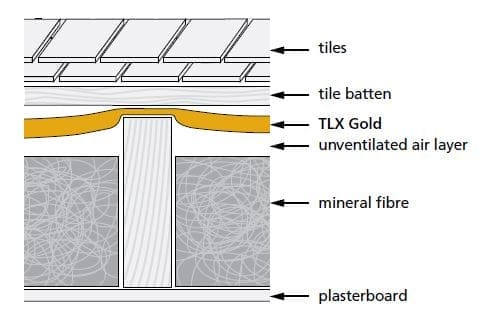 Sometimes, if there are 100 mm deep irregular rafters (without purlins below) and it is not possible to put anything underneath because there is no headroom, the only place insulation can be fitted is between the rafters. Rigid board is not an option, however, where the rafters are very irregular. Mineral wool is then the preferred option. 50mm Rockwool compresses to the rafter edges without leaving gaps through which air (and heat!) can pass. This achieves 0.42 W/mK. Other brands which come in 50mm thickness are Isover Metac and Knauf Omnifit slab.
If your buildup needs to be completely breathable
You require a completely breathable build up. Even though not having a vapour barrier below would permit water vapour to migrate through the ceiling to the cold side of the insulation where it could condense. Here TLX Gold is of particular value, because occupying as it does the coldest part of the temperature profile, it means that a dewpoint cannot form “ so there is no risk of interstitial condensation.
What if you’re working from the inside?
The opposite scenario, of where the existing roof covering is to be left in place, but the rafters are so irregular that even applying shims cannot create a straight surface, is where TLX Silver can sometimes be of use where a build up incorporating a vapour barrier is required. It is able to conform to the lower surface of the rafters, being stapled to the underside. And then secure with a 38mm deep cross batten, fit plasterboard to achieve a flat ceiling. If it is possible to fit 50mm mineral wool between the rafters, you can achieve a respectable 0.31 W/mK.
Suitable for walls?
For old timber-framed walls where timber is visible internally, apply TLX Gold to the outer face. Then fit plasterboard between the studs.
U Value scrutiny vs. Building aesthetic
Although these U-values may seem considerably worse than the 0.18 W/mK required by the current Building Regulations, when you consider that an uninsulated roof has a U-value of 3.87 W/mK, then a U-value of 0.69 W/mK corresponds to saving of 82% of the heat lost through the rafters, as compared with a 95% saving with 0.18 W/mK. If you have to somehow compromise between not raising the roof height versus not losing headroom, of having a breathable build up yet not worrying about interstitial condensation, achieving good thermal insulation but without significantly altering the building’s character and fabric, then TLX Gold insulating breather membrane can provide the answers.