
8 Minute read
Do you regularly enter your home after a long winters’ day to discover that your house is cold and unwelcoming? Alternately your home may feel as warm as a sauna during summer. What could be the issue? It is likely down to your insulation quality¬Â¦ or absence of it.
- Condensation – this can cause lasting structural damage
- Are your energy bills very high? This could be due to lack of insulation
Up to 25% of the heat lost in a home is through the roof space, requiring additional expenditure on the heating.
Use Flat roof insulation to augment a building’s energy proficiency and limit heat dissipation. Insulating a flat roof can prompt lower energy use, a reduction in condensation, and a reduction in related household bills.
 What is flat roof insulation?
A flat roof has a 10 degree pitch, or lower. A flat roof is quite simple to spot. Additionally, flat roofs don’t have the space that you regularly partner with pitched roofs, so, they are generally a bit trickier to insulate.
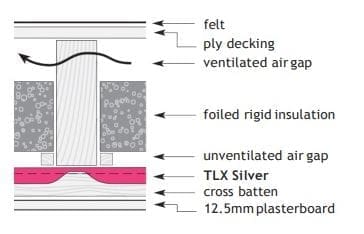
Cold Flat Roofing: The traditional flat roof system has insulation between and under the rafters, with a 50mm ventilated air space under the timber deck.
Why flat roof insulation?
Warm air rises, and most energy loss happens through the roof. Flat roof insulation is a fundamental device used to upgrade the energy proficiency of a building and reduce energy costs.
Where are flat roofs typically found?
- Skyscrapers
- Industrial units
- Business offices
- Schools
- Medical clinics
- Private homes
Flat roofs are a fundamental feature of the current UK building stock. This developing pattern for functional flat roof spaces brings much more interest for efficient insulation systems.
Problems with insulating a roof
What are the most common flat roofing issues?
1. Ponding
Flat roofs don’t have good drainage, so they usually create ponding water which can start to weigh on the timber deck and wear it out over time.
2. Blistering
Flat roofs can blister when little pockets of air or moisture get caught underneath the film. This deteriorates when the sun warms the roof up, which causes the pockets or air or moisture to grow, extending the film.
3. Warm development
Temperature changes can cause the roofing material to grow and contract, which is standard. You must watch out for this because continual extension and withdrawal can debilitate the roof and cause spills. Warm development can result in it pulling away from the edges of your roof over the long haul “ leaving space for spillage and moisture passage into your roof.
How Multifoil insulation can help
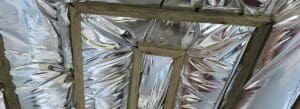
Multifoil insulation is a robust vapour barrier. It stops water vapour from getting into the roof structure, removing the chance of interstitial condensation.
Water vapour pressure inside the house is more prominent than the pressure outside. Water vapour carried in warm air will try to escape and this occurs through adequate ventilation. Vapour will attempt to diffuse through the dividers and roof but, with TLX Silver, ventilation is not required.
Condensation inside the structure of the roof, known as interstitial condensation, can have an unpleasant effect because the abundance of water can prompt mould development and even structural damage.
That is the reason TLX Silver Approved Solutions contain an investigation into the danger of interstitial condensation, calculated to BS EN ISO 13788, which shows no risk of surface or interstitial condensation.
TLX Silver multifoil insulation has reflective, intelligent outer layers to keep heat inside the building. It is also the optimum thickness of 30mm, so it gives the best thermal benefit without compromising on space. This is particularly important when insulating a structure that is short on internal space, given the required 50mm ventilated air layer needed beneath the timber deck.
TLX Silver multifoil insulation is fully BBA certified, a particularly prestigious level of acknowledgement, and has LABC registered detail status.
How to achieve building regulations using a Multifoil
You must follow building regulations when insulating a flat roof with multifoil insulation.
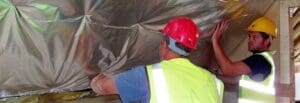
Multifoil insulation will help you meet the required U-value when used in conjunction with rigid board or mineral wool. TLX Silver is particularly successful at preventing air penetrability into the rafter space by fixing to the underside of rafters. The easiest way to alter the U value of the overall structure is to alter the thickness of additional insulation.
You can meet building regulation requirements, 0.18w/m2k, with 100mm of PIR board fitted between a 180mm rafter and TLX Silver underneath the rafter, based on 400mm rafter centres. However, if the space within the rafter permits, you can reach 0.13w/m2k with 160mm of PIR between a 240mm deep rafter.
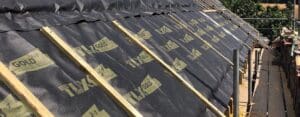
Why you can only use TLX Gold in a pitched roof
Building regulations require a minimum 50mm ventilated air layer underneath the timber deck for a flat roof system. This is vital as it shields the roof space from extreme temperature varieties which can result in the build-up of moisture.
Along these lines, the TLX Gold multifoil insulation requires an optimum 20mm unventilated air gap underneath to ensure the reflection of heat. Water vapour doesn’t require a channel to get away from the roof as it can go through the layers of the multifoil into the tile secure space above and out through the tiles. Ventilation is just required above TLX Gold where the tiles are non-breathable, to stop condensation occurring between the tiles and the upper surface of TLX Gold.
 Our recommendations:
Flat roof insulation will enormously affect the energy proficiency of your property. Getting the insulation right the first time will manage the long-term risk of condensation and determine a decrease in energy costs going forward. Installing the material correctly will allow the roof structure to fulfil its projected life expectancy, which, in terms of TLX Silver, has the lifespan of the roof in which it sits.