8 Minute read
-
Buildings with boarded roofs are more common than you might think
-
What are the best solutions when tackling the insulation of a boarded roof?
Various types of buildings have boarded roofs
Buildings with boarded roofs range from churches, church halls, schools, big Victorian houses and pubs to agricultural barns and garden sheds. The insulation strategy may be different according to the particular situation.
If you are not re-roofing, the only option is to insulate under the boarding, between the rafters. This requires a 50mm ventilated space to be left under the boarding. This is not considered sufficiently vapour-permeable to avoid condensation. Especially when it is the external covering and not ventilated below.
Not possible to insulate under the boarding?
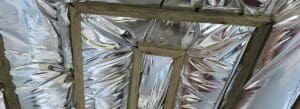
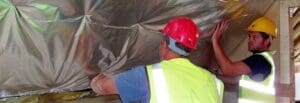
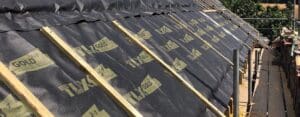
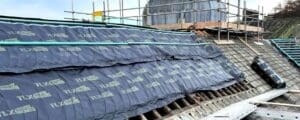
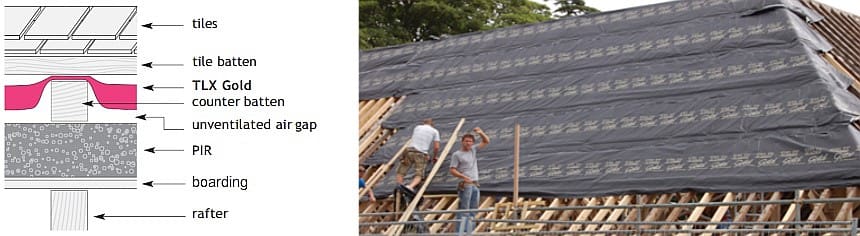
If it is not possible to insulate underneath the boarding because of an existing ceiling or insufficient depth, then the TLX Gold boarded roof solution is ideal. Set 50mmx 50mm counter battens over the boarding. They act as mini-rafters. Then TLX Gold is draped over them in the usual way with a slight sag between the rafters to allow the passage of water down to the guttering. The tile battens can then go straight over, since the TLX Gold compresses to 3mm underneath them. The counter batten depth can NOT be reduced as the 50mm depth is essential to have enough room for the drape, the product thickness and the unventilated heat-reflecting air gap underneath.
What if the external roof covering is Metal or Fibre cement?
If the external roof covering is metal or fibre cement then these must have a 50mm ventilated space underneath them. With air flow from eaves to ridge, as they are not ‘air-open’ like natural materials. TLX Gold would then need to be taut and counter battened, by sandwiching between two 38mm x 38mm counter battens.
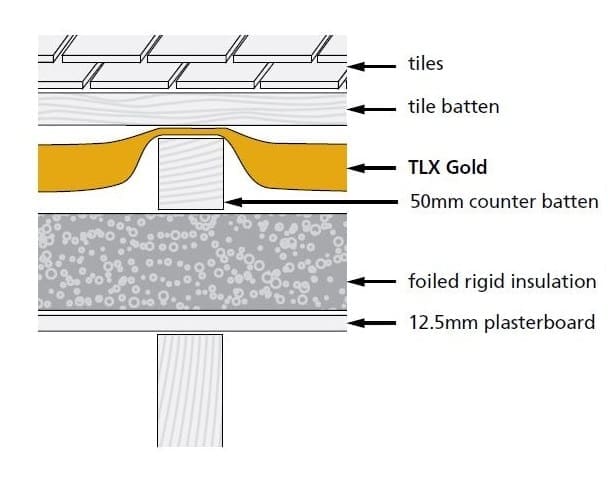 Just having TLX Gold by itself over the boarding achieves a U-value of 0.69 W/mK over exposed rafters “ better than the 0.70 W/mK required for a Listed building. If there is plasterboard under the rafters beneath this improves to 0.60 W/mK because of the additional enclosed air space beneath. If there is room to raise the roof further, set some insulation board over the boarding under the counter battens. Using 25mm PIR board, for example, would achieve 0.38 W/mK.
Often house owners want the insulation over the boarding so that they can have exposed rafters. But unless it is a Listed building this will need to be justified to building control for them to accept a worse U-value than 0.18 W/mK.
There should be no risk of condensation over the boarding when using TLX Gold, assuming that it is close boarded. If, however, there are ¬Ëœpenny gaps’ in the boarding then water vapour carried by movement of air can occur. And it would be advisable to use a vapour barrier above the boarding. For the same reason, you should seal any gaps around penetrations, e.g. using polyurethane spray foam.
Can you put insulation board both above and below the boarding? In principle, yes, since the boarding is no longer the outermost layer that BS5250 would require to have a 50mm ventilated space beneath it.
What about condensation risk?
A condensation risk calculation would show whether or not condensation is likely to occur underneath the boarding. However such calculations are for idealised situations. They don’t account for the gaps between the rafters and the insulation, which allow the passage of moisture laden air. It is essential to have a good vapour barrier underneath if there is such a build up.
We can help you with a condensation risk analysis – call our technical department on 01204 674730
There are various types of room suitable for this application
Garden rooms can range from luxurious cabins requiring the full U = 0.18 W/mK insulation that will satisfy Building Control, to basic log cabins with no insulation fitted. Sometimes a conventional build up with a vapour barrier internally may seem to be the obvious way to go. But you would design such build ups for situations where is a constant relatively warm indoor temperature, and people inside generating the usual domestic amount of water vapour from cooking, washing, etc. TLX Gold without a vapour barrier may well be the best option depending on the use of the building.
For example, if the room has use as a home gym, possibly with a shower, a lot of moisture can generate for short periods of time. But if the room is not in use most of the time, moisture would be trapped internally if a vapour barrier were used. Plus, condensation might occur on walls if not mechanically ventilated. In such situations TLX Gold allows gradual dissipation of internal water vapour. A garden room as a home office with only one occupant keeping warm for most of the day, and windows with trickle vents, would not have the same problems and a build up employing a vapour barrier would be fine.
TLX Gold insulating breather membrane has transformed the possibilities for boarded roofs, especially for large community buildings where heating costs have become exorbitant. In reducing the U value from the 3.85 W/mK of a roof with no insulation down to 0.69 W/mK, 82% of the energy being lost through the roof is saved.
Further reading: Case Study / Technical Solution